English translation · S. Rouzbeh
Blood on the Clergy’s Robes: Who Justified the Killings?
Melliun Iran · 23 November 2026
رد خون بر عبای روحانیت؛ چه کسانی کشتار را توجیه کردند؟
English translation of the Persian article by S. Rouzbeh, provided on the author’s website. The publication date and the article’s historical context are preserved.
When a bullet strikes a protester in the chest, responsibility extends beyond the person who pulled the trigger or gave the order to shoot. We must ask who used their religious standing, before and after the killings, to give violence a religious justification. Who called political opponents mohareb, baghi or enemies of the faith? Who, after protesters were executed, called for harsher punishments instead of questioning the fairness of the proceedings or defending the right to life?
To answer these questions, we must look at the religious backing for repression: the part of the state-aligned clergy that at times issued orders, at times justified them, and at times sided with those in power after blood had been shed.
From Khomeini’s decree to the 1988 executions
One of the clearest examples of the link between religious authority and political killings is the execution of prisoners in the summer of 1988. Ruhollah Khomeini issued a decree that paved the way for the mass execution of political prisoners affiliated with the People’s Mojahedin Organisation of Iran. In carrying out the decree, religious judges and judicial and intelligence officials sat on panels that decided the fate of prisoners.
Here, the religious ruling went beyond justifying the killings after the event. It was an order that became part of the machinery of execution. Amnesty International examined the decree and the related correspondence in its report Blood-soaked Secrets.
The chain murders: fatwas still shrouded in uncertainty
In the case of the chain murders of the 1990s, the question of religious authorisation to eliminate opponents arose again.
A text published as part of Saeed Emami’s interrogation claims that some killings were justified as the fulfilment of a religious duty and that Ali Fallahian sought clerics’ opinions in sensitive cases.
The account names Azizollah Khoshvaght, Mohammad-Taqi Mesbah-Yazdi, Abolghasem Khazali and Ahmad Jannati.
The text’s authenticity and the allegations concerning the people it names have yet to be independently established. The claim that they ordered killings therefore remains unproven.
The central question remains: did those who carried out the killings seek religious authorisation for their actions and, if so, who granted it?
When terms from religious jurisprudence become instruments of political punishment
Moharebeh (waging war against God), baghy (rebellion) and mahdur al-dam (a person whose blood may be shed with impunity) are terms with specific definitions and conditions in Islamic jurisprudence. The problem arises when these concepts are used to justify action against political opponents.
In early 2018, in response to protests, Ahmad Khatami used the term baghi for those he described as ringleaders of the violence and spoke of the death penalty.
In December 2022, after Mohsen Shekari was executed, an Islamic Republic judicial official cited Khomeini’s Tahrir al-Wasilah in defence of the punishment for moharebeh.
These cases raise a question that goes beyond the application of the law: how does a religious interpretation of crime and punishment come to be used in defence of taking human life?
November 2019: the pulpits after the killings
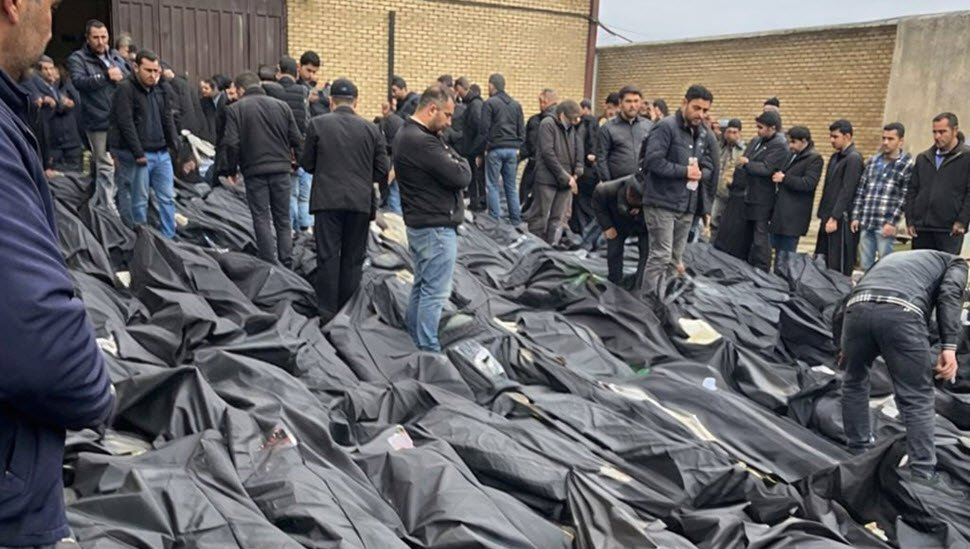
During the November 2019 protests, government forces killed large numbers of protesters. Amnesty International documented the deaths of at least 323 people.
At Friday prayers on 22 November, Ahmad Khatami defended the Islamic Republic’s leader, framed the protests as an enemy conspiracy and supported keeping internet restrictions in place.
In Mashhad, Ahmad Alamolhoda also spoke about detainees and the role of alleged organisers.
These statements formed part of the religious and political narrative backing the government in the days after the killings, although they did not constitute orders to shoot. Why did platforms that could have demanded accountability for the deaths of citizens largely focus, in these instances, on defending public order and the government’s security narrative?
2022: open support for executions from the seminary
During the 2022 protests, religious support for the death penalty became more explicit.
In a statement on 23 December 2022, the General Assembly of the Society of Seminary Teachers of Qom supported the executions of Mohsen Shekari and Majidreza Rahnavard, describing them as ‘exemplary executions of those convicted of moharebeh’.
An organised seminary body had published a statement endorsing the execution of two protesters. It went beyond the words of an individual Friday prayer leader.
Around the same time, Ahmad Khatami also called for severe judicial action against those he described as responsible for violence.
When a religious institution defends an execution that has already taken place, what moral responsibility does it bear for the judicial proceedings, for confessions that may have been extracted under torture and for the right to life of those sentenced? What does endorsing a death sentence without an independent review of the proceedings amount to, other than lending religious authority to the judiciary’s decision?
January 2026: from support for the government to calls for the death penalty
During the January 2026 protests and after the killings on 8 and 9 January, statements by several state-aligned clerics again appeared in support of severe punishment.
On 13 January, Abdolmajid Maghami, an official in the General Assembly of the Society of Seminary Teachers of Qom, called for penalties for moharebeh to be imposed on people he described as rioters.
In his sermon on 16 January, Ahmad Khatami spoke of severe punishment and the execution of those he described as responsible for killings and terrorist acts.
Around the same time, statements by Nouri Hamedani and other seminary figures in support of the leadership and government were published. There would need to be evidence before such statements could be treated as orders to kill.
The timing of these statements matters. As many families searched for the truth about those who had been killed, some religious platforms emphasised punishment and the authority of the state instead of calling for an independent investigation.
Who answers for legitimising the killings?
From the decree behind the 1988 executions to seminary support for the execution of protesters in 2022 and calls for severe punishments in January 2026, the documented record establishes that part of the state-aligned clergy has, at different times, played a role in ordering killings or lending religious legitimacy to lethal punishments.
Those who order killings bear a different responsibility from preachers who support the punishment. Those who justify the killings still bear moral and political responsibility.
Anyone who uses the authority of religion to defend the taking of human life must answer for their words and their consequences.
The trail of blood leads beyond the hand that pulled the trigger. We must ask who stood in the pulpit and gave religious justification for what happened.