
Selected Article · 7 September 2026
The Second Tanker War: Is the Islamic Republic Repeating the Mistake It Made Forty Years Ago?
Download the English text ↓ · Read the Persian original ↗
From the fast boats of the 1980s to today’s ballistic missiles, the weapons have changed—but has Tehran’s strategic calculus changed too? A comparison of the tanker war and the present-day confrontation in the Persian Gulf.
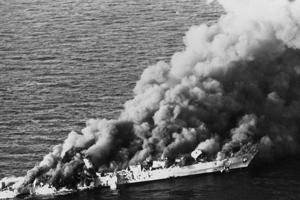
From the fast boats of the 1980s to today’s ballistic missiles, the weapons have changed—but has Tehran’s strategic calculus changed too?
S. Rouzbeh — Gooya Newsletter
Is what we are seeing today in the Persian Gulf the beginning of a new version of the “Tanker War” that brought Iran and the United States into direct confrontation nearly four decades ago?
More importantly, despite forty years of experience and the development of missiles, drones and naval equipment, is the Islamic Republic repeating the same strategic mistake it made in the final years of the Iran–Iraq War: entering a conflict that the other side has greater capacity to expand and sustain than Iran does?
For a generation that does not remember the Iran–Iraq War, the “Tanker War” may be no more than a historical phrase. But in the second half of the 1980s, the Persian Gulf had effectively become part of the battlefield. Iraq targeted ships and oil facilities to strike at Iran’s oil exports, while the Islamic Republic attacked ships it considered connected to Iraq and its supporters.
At the time, IRGC fast boats armed with machine guns, RPGs, rockets and relatively simple weapons would approach tankers, open fire and leave the area quickly. Mines, too, became one of Iran’s important tools.
But the problem grew much larger when the war no longer remained between Iran and Iraq.
Kuwait requested help to protect its tankers, and in 1987 the United States launched Operation Earnest Will. Kuwaiti tankers sailed under the American flag, escorted by US warships. Suddenly, the Islamic Republic was facing a far greater power in the very waters where it had sought to impose a cost through mines, boats and sporadic attacks.
In April 1988, the USS Samuel B. Roberts struck a mine and was severely damaged. Four days later, in Operation Praying Mantis, the United States targeted platforms used by Iran for military purposes and several Iranian naval vessels. The frigate Sahand was sunk and the Sabalan was severely damaged.
Iran’s mistake was not simply that its boats and vessels were weaker than the US Navy. The more important issue was that Tehran took its asymmetric warfare to a point where a power with overwhelming naval and air superiority entered the conflict directly.
Now, nearly four decades later, part of that same scene is unfolding again—but with entirely different weapons.
According to US Central Command, on 5 September 2026 Iran targeted two US military vessels, including an aircraft carrier and a destroyer, with ballistic missiles. US officials say the vessels evaded the attacks and there were no casualties. Given the pace of events and the lack of sufficient independent information, any claims about possible hits or damage should still be treated with caution.
What is clearer is the US response: three tankers linked to Iran were targeted.
This is where the historical parallel begins.
Of course, Iran today is not the Iran of 1987. Back then, an attacker had to bring a boat close to a tanker. Today, the Islamic Republic has an array of coastal and anti-ship missiles, ballistic missiles, drones, mines, radar and fast boats, and an attack can be launched from much farther away.
The United States, too, is no longer the navy it was in 1988. Its layered defence systems, advanced radar, airborne early-warning aircraft, electronic warfare capabilities, submarines and intelligence networks have greatly enhanced its ability to detect and counter threats.
So today’s war is no longer just “boats versus warships”; it is a battle between two military and intelligence networks.
But possessing new tools does not necessarily mean having a new strategic calculus.
For four decades, the Islamic Republic has invested in the assumption that it can raise the cost of America’s presence in the region through missiles, drones, mines and asymmetric warfare. This logic works only so long as the conflict remains at a level that does not prompt the other side to bring all its military and economic superiority to bear.
If attacks on American warships and vessels lead Washington to target not only missiles and boats but also the lifeline of Iran’s oil exports directly, the question posed forty years ago will arise again:
Which side can endure a longer war?
In 1988, the Islamic Republic was not facing military pressure alone. After nearly eight years of war, Iranian society was exhausted, the economy was under strain, many families had suffered losses, and defeats on the ground had also changed the government’s calculations. Acceptance of Resolution 598 was not the result of a naval battle or a single incident; it came from a combination of military, economic, social and political pressures.
Today, too, the ability to continue a war cannot be measured solely by the number of missiles.
Iranian society has entered this phase after the killing and severe suppression of protests last December, amid a collapsing currency, heavy inflation, rising prices and economic hardship that have made life difficult for a large part of the population. Quieter streets do not necessarily mean that social anger and exhaustion have disappeared.
In such circumstances, each new round of war could link external pressure to an internal crisis.
This time, by targeting Iranian oil tankers, the United States has sent a message that goes beyond a purely military response: the cost of attacking American forces could be exacted from the Islamic Republic’s economic lifeline.
Iran can fire missiles, threaten tankers and drive up the cost of shipping in the Persian Gulf. But the United States, too, has the ability to strike tankers, missile facilities, radar systems and Iran’s oil-export network.
So the central question is not whether Iran can harm the United States; it is clear that it can impose costs.
The more important question is which side, in each round of attack and retaliation, will reach the limits of its economic, military and political endurance first.
History does not repeat itself exactly. Today’s Iran is different from Iran in 1988, the United States has changed, and the regional circumstances are not the same as they were forty years ago.
But miscalculation can be repeated.
Forty years ago, the Islamic Republic realised too late that raising the cost for its enemy did not mean it would be spared the cost itself. As the war expanded, its pressure increasingly rebounded on Iran, and, alongside military and economic developments, forced the government to change its calculations.
Today, missiles are more precise, drones more advanced and weapons have greater range. But one old question remains:
Will the Islamic Republic change course this time before the pressure of an external war, combined with economic exhaustion and domestic anger, reaches a critical point—or have only the weapons changed, while the same calculation from forty years ago remains in place?