
Selected Article · 28 August 2026
The Slogan the Government First Condemned, Then Reproduced
Download the English text ↓ · Read the Persian original ↗
How the Islamic Republic shifted from rejecting national symbols to invoking Iran, the homeland and Iranian historical memory in its official propaganda during times of crisis.
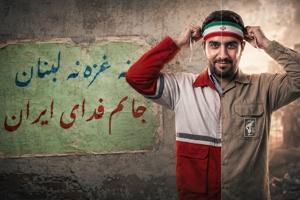
From condemning “My life for Iran” to “A life given for Iran”
The government’s changing language of identity: from the Islamic ummah to the propagandistic use of Iran’s name
S. Rouzbeh — Gooya Newsletter
Why does the Islamic Republic now reuse symbols it once rejected?
How did “My life for Iran” go from a condemned slogan to “A life given for Iran” in the government’s official propaganda?
And why does a government that has spent nearly half a century shaping its own official culture turn, in times of crisis, once again to “Iran”, “the homeland”, “the motherland” and Iranians’ historical memory?
To answer this, we must return to the Islamic Republic’s earliest days.
On 10 Esfand 1357, less than three weeks after the revolution, Ruhollah Khomeini called for the removal of the Lion and Sun from ministries and government offices, describing it as one of the “vestiges of the age of tyranny” and as “ominous”. “Islamic emblems” were to take its place.
This was not merely a change of emblem. The new government was offering a different definition of the country’s political identity, placing political Islam and the revolution at its centre. Khomeini later explicitly criticised nationalism, saying, “Nationalism is the root of Muslims’ misfortune.” In his view, national identity, if set against the Islamic ummah, was a source of division.
The Islamic Republic was therefore not without an identity or culture from the outset. On the contrary, it built its own distinctive political language and culture: revolution, martyrdom, Velayat, the dispossessed, the Islamic ummah and, later, “resistance”, “Defenders of the Shrine” and the “Resistance Front”.
But another question remains: to what extent has all this cultural production become a shared inheritance of a nation?
Over four decades, the Islamic Republic has established a vast network of broadcasting, the Islamic Propagation Organisation, the Hozeh Honari arts organisation, foundations and cultural institutions. The Academy of Persian Language and Literature has also drawn on public funds for years; around 237 billion tomans had been earmarked for it in the 1405 budget bill.
It would not be fair, of course, to say that the Academy has done “nothing”. It has approved tens of thousands of specialist terms and advanced major projects such as the Comprehensive Dictionary of the Persian Language. But approving words is not the same as creating a living national language.
Cultural and symbolic capital is something people preserve themselves; they use it in poetry and everyday life, repeat it in moments of crisis, and do not need official directives or a budget to keep it alive.
This is where the story of “My life for Iran” takes on significance.
During the 1388 protests, the slogan “Neither Gaza nor Lebanon, my life for Iran” became one of the signs of opposition to the Islamic Republic’s regional policy. Some in the government’s official camp rejected it fiercely. Mohammad Bagher Ghalibaf even said that the protesters’ “My life for Iran” was “false”, and years later called it “the most mistaken and most dishonest slogan imaginable”.
But a few years later, the same phrase returned in a completely different context.
During the Dey 1404 protests, “My life for Iran” was heard again, while among opponents, expressions such as “A life given for the homeland”, “Child of Iran” and “eternally remembered” gained currency for some of those killed.
A few months later, a campaign called “A Life for Iran” took shape. Government officials and media joined it, and this time Ghalibaf wrote: “Mohammad-Bagher Ghalibaf, a life for Iran.”
Factnameh reported that the Islamic Revolutionary Guard Corps’ Qorb-e Baqiatollah Cultural and Social Headquarters had played a part in launching the campaign. Before this, “a life for” and “a life given for the homeland” had also appeared in opponents’ discourse about those killed in the protests.
This evidence alone does not prove that the campaign’s designers deliberately “stole” a word used by opponents. But it does reveal a political contradiction: a phrase once called “falsehood” and a “lie” later found its way into government propaganda.
This pattern is not limited to “a life for”.
In 1401, “Woman, Life, Freedom” became the main slogan of the protests. At the same time, government supporters coined “Woman, Life, Martyrdom” in response. Shervin Hajipour’s song “Baraye”, which emerged from people’s demands on social media and whose creator faced a judicial case, was later used in the form and structure of election propaganda.
“Javidnam” (‘forever remembered’) also requires precision. The word is far older than the Islamic Republic and the recent protests, and it cannot be said that opponents coined it. What is new is its political use as an alternative to “martyr” in part of the opponents’ discourse. Later, even the conservative Quds newspaper wrote that those killed, “whether martyrs or forever remembered, are the children of Iran”.
Here, the issue is no longer a single word; it is the shifting boundaries of political language.
Reuters also reported in May 2026 that the Islamic Republic’s official propaganda had moved more towards nationalist themes, compared with its earlier emphasis on religious and revolutionary messaging. In the report, Ali Vaez of the International Crisis Group linked this shift to the waning appeal of the old ideology among some sections of society and the government’s need to draw on other elements of Iranian identity.
Perhaps here we should distinguish between two concepts: “government culture” and “national culture”.
The Islamic Republic has produced a great deal of government culture. But whether that culture has managed to become a shared language among Iranians without a budget, official media and political power is another question.
Ferdowsi did not need the Ministry of Culture and Islamic Guidance in order to endure. Hafez does not need the national broadcaster to remain alive in people’s memory. Norouz, Iran, the homeland and the motherland existed before the Islamic Republic, and belong to no particular government.
From this perspective, perhaps the main issue is not a “poverty of words” but a poverty of symbolic capital.
A government that initially denounced nationalism and rejected the Lion and Sun now speaks of Iran, the homeland and the motherland more than ever in moments of crisis.
So the final question remains:
After nearly half a century in power, if you still have to return to that same historical memory and that same national language in order to speak to the nation, how far has your own cultural project managed to go, and what is it that you have made your own? Even the word “martyr” is an Arabic word that entered the Iranian language. How far has it become a shared language among Iranians?
From the Lion and Sun to “A Life for Iran”, this is not just a story about a few words; it is a story about the struggle over the meaning of “Iran”.