
Selected Article · 12 September 2026
The Seventh Moment of Silence on 11 September This Year: What Happened in Iran’s Silence?
Download the English text ↓ · Read the Persian original ↗
As New York adds a seventh moment of silence to remember those who died in the years after 9/11 from related illnesses, S. Rouzbeh asks how many victims and survivors of repression in Iran remain unknown—and how enforced silence has concealed their names and suffering.
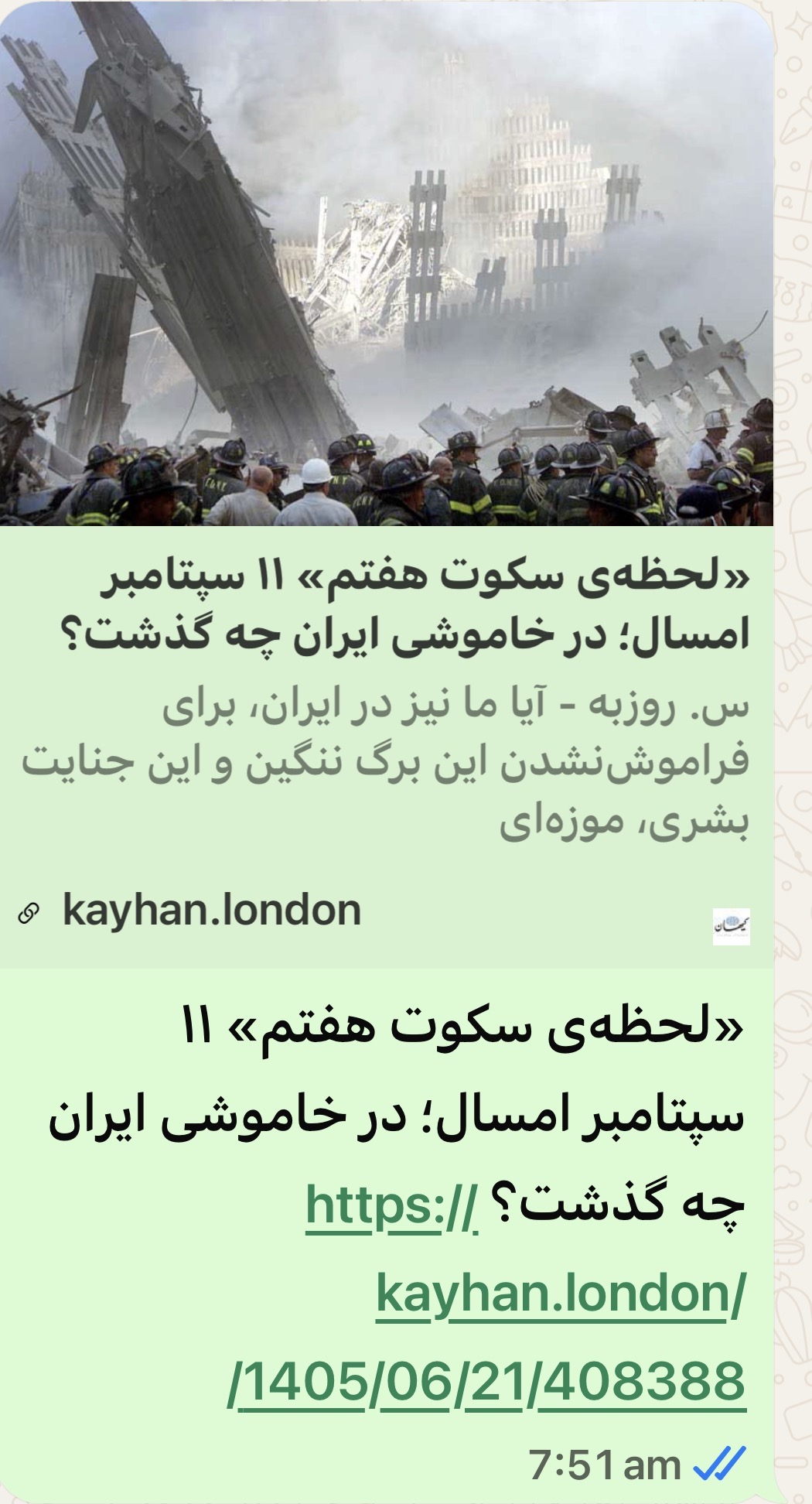
S. Rouzbeh – Will we, too, build a museum in Iran to document the regime’s crimes and a memorial to those who lost their lives, so that this shameful chapter and this crime against humanity are not forgotten? A memorial that, inspired by the ways the memory of Holocaust victims and the victims of 11 September has been preserved, keeps the names, documents and accounts of this catastrophe alive for future generations? Why does this matter?
Last year, in an article about 11 September, I referred to the gathering of people in Iran after the attacks: people who chanted slogans, expressed solidarity with the victims’ families and lit candles in memory of people killed thousands of kilometres away. Before seeing the victims as Americans, they saw them as innocent human beings.
This year, on the twenty-fifth anniversary of the 11 September attacks, a meaningful change is due to be made to the New York ceremony. Alongside the reading of the victims’ names and the six customary moments of silence, a ‘seventh moment of silence’ will be held for the first time. What does this silence mean? This new moment of silence is dedicated to those who were not killed on the day of the attack, but died in the years that followed from related illnesses and injuries.
At the annual 11 September ceremony, six moments of silence recall the times when the planes struck the World Trade Centre towers, the two towers collapsed, the Pentagon was attacked and Flight 93 crashed. This year, a seventh moment will be added so that those who lived for years with cancer, respiratory illnesses and the physical and psychological consequences of the catastrophe are not erased from public memory. According to an official announcement by the National September 11 Memorial & Museum, the victims’ names will once again be read by members of their families.
The meaning of this decision is clear: the number of victims of a catastrophe is not limited to those who die on the day itself. The injured, those who live with disability and illness, and families who carry the burden of the event for years are also part of that catastrophe.
But in Iran, we do not even know how many survivors of our own repression there are, where they live or what their circumstances are today.
The Islamic Republic has announced that a total of 3,117 people were killed during the Dey 1404 protests and the January 2026 crackdown—a figure higher than the 2,977 direct victims of the 11 September attacks. The government has tried to reshape the accounts in its own favour and has provided no independent, verifiable figures. Even if we rely only on the government’s own official figures, that number alone shows the scale of the catastrophe. The government has never published clear figures for the number of injured people, those blinded or those left with disabilities. Meanwhile, figures released by human rights organisations exceed the official government toll, with estimates of 40,000 to 52,000 or more. Restrictions on communications have also made it difficult to independently assess the scale of the killings.
If the United States is still expanding its understanding of who counts as a victim, twenty-five years after 2,977 people were killed, how much do we know about our own victims and survivors?
And why is a new moment in public memory created for those who die years after 11 September from its after-effects, while the number of people killed, injured and disabled in Iran’s crackdown remains unknown?
In New York, silence is for remembrance; in Iran, silence was imposed to conceal.
On the evening of 8 January 2026, as the protests spread, Iran’s connection to the global internet was almost entirely cut off. Iranian internet traffic initially fell by nearly 90 per cent and then effectively reached zero. The following day, recorded traffic dropped to less than one-hundredth of one per cent of its pre-shutdown level. This communications blackout was also documented.
This blackout was not merely the loss of a means of communication. It also closed off the routes through which images could be shared, families could make contact, doctors could report and victims’ names could be recorded. In that same darkness, government forces were able to surround streets and suppress protests away from independent journalists and out of the world’s sight.
One remains silent so that the victims’ names can be heard; the other silences everything so that their names cannot be heard.
Reports that made it out of Iran with difficulty described live ammunition and pellets being fired at people’s heads, faces, eyes, chests and other parts of their bodies. But clearly, not every bullet struck the heart, head or chest; and, judging by the pattern of such crackdowns, the number of wounded, injured and disabled people is greater than the number killed. Many of the wounded did not dare go to hospital for fear of arrest. Some were treated at home with basic resources, while doctors and nurses also helped them outside official medical facilities.
The Guardian, citing doctors, reported that a single eye specialist at one Tehran hospital had recorded more than 400 cases of eye injuries caused by gunfire. Doctors and nurses also spoke of security forces entering hospitals to arrest the wounded. Some of those injured lost one or both eyes, while others suffered lasting physical harm.
We still do not know how many people live with bullets or pellets in their bodies; how many have lost their sight, mobility, some aspect of their health or a part of their body; how many wounded people have been denied proper treatment because they fear arrest; or how many families still do not know the truth about the death or fate of their child.
A survivor is not only someone who made it out of the place where shots were fired. A young person who has lost an eye, an injured person living with a disability, a doctor threatened for treating a protester, a mother unable to mourn her child freely, and a family still afraid to speak the truth are all survivors of this catastrophe.
The people of Iran wept for their dead, lit candles and held memorial ceremonies despite the threats. Iranians abroad, too, held pictures of the victims in cities around the world and shouted their names. These scenes are not limited to the recent protests. For years, people have lit candles for protesters killed, people executed and prisoners whose lives have been taken. Crimes, executions and mourning have followed one another, without the previous case ever reaching justice.
The world did not remain entirely silent either. Governments and international bodies issued statements, condemned the repression and imposed sanctions. But verbal condemnation is not the same as an effective response. Those who ordered and carried out the killings have still not been held to account before an independent court, and many families and the injured have received no effective international support.
The purpose of comparing these two tragedies is not to diminish 11 September or to set up a contest between victims. Human lives cannot be assigned value in a table of figures. The issue is the difference between two kinds of memory and two kinds of silence: a society that, even after twenty-five years, continues to strive to forget no victim or survivor, and a government that cuts off a nation’s connection with the world to conceal the scale of its repression.
Twenty-five years ago, the people of Iran lit candles for the victims of 11 September because they were human beings. Today, too, Iran’s victims had names, families, hopes and futures. Our survivors, too, have the right to be seen, to receive treatment and to have their stories recorded without fear.
We, too, will build a museum to document the regime’s crimes and a memorial to those who lost their lives, so that this shameful chapter and this crime against humanity are not forgotten—not to equate these tragedies, but inspired by the way the memory of the victims of the Holocaust and 11 September has been kept alive. We will bring together the scattered memories of this tragedy there, and show the names, photographs, documents and accounts to future generations and the world, so that neither the people of Iran, nor history, nor future generations will forget it; so that they are never deceived and learn to value their freedom and democracy.
This year, New York adds a seventh moment of silence to the memory of its victims. But in Iran, the names of many of those killed, the number of people injured and the fate of survivors remain trapped in the very silence the government imposed on the country.
If the killing of thousands of people, the wounding of many more and the silencing of an entire country are not enough to break this silence, how much longer must Iranians wait for the world to speak, and how much longer must the world wait to hear the names of more victims and perpetrators?